UK Crypto Tax: Make sure you disclose your gains, or you could face big penalties
If you own cryptocurrency in the UK, you need to know how much tax you have to pay. HMRC views Bitcoin and other cryptocurrencies as taxable assets and has a data sharing program with UK exchanges.Because HMRC sees crypto as a capital asset, when you dispose of a capital asset – you’ll pay Capital Gains Tax.eg selling crypto for a fiat currency, or another crypto currency, or spending it or gifting it.
Also the government recently announced a cut to the Capital Gains Tax allowance from £12,300 to £6,000 from April 2023.
Don’t get caught out, find out how much tax you have to pay on your crypto in the UK now.
Did you know about this? What do you think about it, and do you have any questions? Please comment.
So my name is Keith Griggs and I just wanted to talk a bit about this lockdown caused by the Coronavirus and how I think we should respond to it. In particular, how we should respond to it in terms of our business.
So I mean obviously it's causing incredible suffering to many thousands of people all over the world and it will almost certainly touch our families and friends as well. So it's a horrific thing.
But some people seem to be just, maybe a bit fearful about it or just shutting down and just using this as a time to just rest and relax and watch Netflix and so on.
But this could go on some time. And I think it's crucial for business that we are very proactive and use this time to our very best advantage. So, that's that sort of thing that I want to talk about today in this video.
So, obviously, I think is vital to stay healthy, stay safe, stay isolated, eat healthily, and go for lots of exercise.
That's definitely one thing. But also I think we can just take a step back, just like at Christmas and in August, the whole world seems to just shut down, which is often quite frustrating to me because I tend to want to plough on and carry on usually in that time.
But it forces me to take a step back and have a real think about things, go back to first principles and work out how everything fits together in my business and how I want to go forward. I think it's very valuable to do that.
Also of course you can also massively improve your digital assets.
You can create new sales funnels. Maybe your website doesn't do a very good job in terms of messaging and so on to take people through different stages from visitors to serve them a different message when they've interacted with your site and content a bit and know you better.
And then eventually they contact you or have some interaction and then you can sell them something cheap or give them something free and then maybe upsell them more expensive later.
So you move them up the value ladder, which is a way of maximising your income from each particular prospect, which is a much, much more profitable way of doing it than trying to acquire new customers all the time and just I'm selling them your standard offering.
Another thing that's really important I think to do is produce a lot of content.
This is content. This is a video, I'm also going to get it transcribed and use it as a blog post, and then also go to extract the audio and use it as a podcast. But the video, I'm going to syndicate it and put on many different places all over the internet, social media website and so on.
Part 2
I'd also like to talk about what I call the four pillars. I've sort of split various avenues into four areas that I think are absolutely crucial to any business.
So the first area is the whole thing about websites and messaging, which I have already touched upon and I will touch upon it a bit more in a minute. There's traffic and retargeting, which is absolutely crucial to get people into your website and to bring them back once they've been there.
Social media is becoming more and more important every day as people spend more and more time on there. And reputation is vital, what people are saying about you online and how you use this to your advantage.
So let's go into these four pillars, these four areas in a bit more depth.
Improving your website messaging.
So taking them on a journey through your funnel, which I've already alluded to, people do need a different message at each stage. A lot of people don't realise that, they just have a website. That's why it's much more ... I think it's very useful to just map out your whole presence on the internet as a sort of funnel and have different messages at different points where people first engage with you and then where people know you better. Take them to a different place in your website and give them a different message. Or it could be on your email list or maybe a Facebook group or something like that.
Also, inject the personality of your brand. In my case, a lot of my brand has actually to do with me, my personality, and that's why I like to use videos a lot to help get that across and help build a sort of connection with the people viewing my content.
Setting up email lists is another great way to improve your messaging too. Just like retargeting it's a great way to sort of capture people and then give you the ability to connect with them further and further into the future as you send them more and more content.
So that was the first pillar. The second pillar is to set up tracking and retargeting pixels, though I hope you've already done this. A lot of people have not.
For example, Google Analytics is extremely useful just to see how people find your site, how long they spend on each page, and their journey from where do they go off to each page. It can give you a lot of feedback about what people like about your site and then that can really help you create more pages, create more contents to give them what they like rather than what they find boring.
Adwords is really good. So if they come to your site, you can ... Maybe you're not advertising on Adwords at the moment, but maybe in three or six month's time you want to retarget who's been to your site so that's why it's good to put your pixel up now. Same thing with Facebook. Same thing with LinkedIn. You can target with LinkedIn ads, people who have been to your site.
And then of course, after capturing their information, we target them, set up ads and follow these people around for the next three to six months. So I have heard it said that 96% of visitors to your website never come back, so when you think about it it's an incredible waste of money to spend a lot of money advertising on SEO to get someone to your site and then never see them again. And the vast majority of people will fall into that category. So that's why it's so important to follow them around. It's also said that we need seven touches with a prospect before they like and trust you enough and know enough about your product and understand the benefits. They're not going to get all that on one time so you need some points of contact before they're ready to actually take out their wallet, take out their credit card and hand over their money.
So in the olden days, this used to be by points of contact by sitting in the emails, speaking to them and so on, but now over the internet we can create a lot more points of contact by retargeting using ads that appear on different sides. So Facebook, for example, giving you different aspects of your message, maybe different angles, different hooks, or maybe you show them testimonials from other people or case studies or something like that.
Part 3
The third pillar is to just be omnipresent, be all over social media. Obviously one way you can do that is retargeting, which is what I said, but make sure you have social media accounts set up on all the major places where your prospects gather. Almost everyone goes to Facebook. That's a great place to go. Even CEOs and B2B customers spend time on Facebook because a lot of them, for example, have children they want to keep in touch with and so on.
The fourth pillar is reputation. People believe what other people say about you much more than what you say about you, because obviously you are biased and you're always trying to present yourself in the best light. Whereas if someone else says something about you, it's much more believable, especially if they seem like a reputable person, you can see the picture and so on.
It's really important to manage your reviews online because you're wasting your money otherwise on advertising. If you have a bad reputation, bad reviews, no one's going to buy from you. You need to fix your reputation first before you invest in anything else. Managing it is very important. Have a system in place so if someone leaves a review, you are immediately notified and can respond to it. You should respond to both good and bad reviews because that just really helps people feel that you're a good company to do business with.
The second part of this is to build your reputation. Proactively approach customers and clients and ask them to leave reviews for you on various platforms. Thirdly, market this. Once someone has left a good review, you should put it on your website, maybe make an image from it, maybe make a video from it, put it on social media, maybe use it in your advertising, just get the word out there.
They're the four pillars. And as well as that, I think it's really good to just take time out just to network with more people because another saying I've heard is that “your net worth is your network” in that although most of the people we network with, it's maybe a waste of time. We might have a pleasant little conversation with people, but now and again we come across someone who has some skill, some idea, maybe they know who can really help us a lot.
And that's just happened time and time again for me. I just think it's a really good thing to just have lots of conversations with people. Maybe they come to nothing, but maybe they could be something that could just totally change the whole way you do business. I think it is great to interact. I think LinkedIn is brilliant for that. I've met so many amazing people on LinkedIn. Reach out, message people, talk to them and hopefully you'll find some people that can really help your business.
Maybe you can find a people, even if they can't provide you a service that your company uses, maybe they're just great people to bounce ideas off because sometimes one little comment from someone can really open up a whole new world of ideas for you. Don't underestimate this, and I think it's a extremely valuable use of our time. That's the end of this video. Please subscribe to my content, like my pages. Please get in touch with me and hopefully see you soon. That's all for now. Bye.
These days it is vital to be all over social media, as almost certainly that is where your customers spend time every day.
Also you need to nurture a first class online reputation. You need to manage your review listings and your reviews, actively build them up, and also use them in your marketing.
I also talk about the importance of increasing your network and just talking to people who may be of benefit in some way to your business. Worst case scenario is that you waste a few minutes having a chat.
In this video I talk about the first two of what I call the Four Pillars.
I believe these should be the backbone of any business that is active on the internet.
To neglect any of these pillars means leaving a lot of money on the table.
The first pillar is website messaging. Your website should take them on a journey through your sales funnel, move them up the value ladder, and familiarize them with the personality of your brand.
The second pillar is setting up tracking and retargeting pixels on your website. This lets you see exactly what is going on with your site, eg how long they spend on each page. You can use this information to guide you to create content and even products that they like the most.
Then with the retargeting pixel you can stay in touch with the prospect.
I talk about what I believe (from a business point of view) is the best way is to respond to this lockdown.
eg taking a step back to really think about things from first principles, and working on improving our digital assets such as sales funnels, messaging, content production and syndication .
As was widely reported a short time ago with much fanfare, Instagram has started hiding likes as a test to see if doing so will make the app more enjoyable for users.
The test started in Canada but has now been rolled out to six additional countries - Ireland, Italy, Japan, Brazil, Australia, and New Zealand.
The fact that they rolled it out in seven major markets makes us confident in saying so as well.
And we think this is a good thing for everyone, including your business.
Here’s Why Hiding Likes Is Good For Your Business
Here are three reasons why we think Instagram hiding like counts is good for your business:
You’ll start tracking metrics that matter
Likes are a false currency. You can’t take them to the bank, and you can’t pay your bills with them. So there is no great reason to make them the focus of your Instagram strategy.
But that’s exactly what’s happened.
It’s time to start tracking the metrics that actually matter, like reach, engagement, saves,
You’ll start sharing content that’s more authentic
Admit it, at one point or another, you’ve held back on something you wanted to post because you didn’t think the Instagram community would like it enough.
Everyone that markets on Instagram have done that! But at what cost?
The cost is that Instagram has largely become a popularity contest, and that has driven people and companies to post images that fall within certain ‘rules’ that give them a better chance of success...which means authenticity has gone out the window.
Now that likes are hidden, our bet is that everyone will feel more comfortable posting content that’s authentic.
The foundation of a good business brand is an authentic connection with its audience, so we think this is nothing but good for business!
You’ll create content that gets real results
Now that you’ll be tracking the right metrics for your content, your Social Media Marketing Manager will now be held accountable to results beyond just likes and follower growth.
That means your content strategy will shift to maximize those metrics and actually drive real business results.
How many visitors are making it to your website? Opting into email lists? Buying products?
Our best is that real business results like these will become the expectation of businesses using Instagram, and the real value of the platform as a marketing tool will become abundantly clear.
Like It Or Not...
Change is coming to Instagram, and we think it’s a good thing! Expect that likes will be hidden in your market within the next six months, and start preparing your strategy now.
Meta: Instagram is now hiding likes and it is actually good for your business. Wondering why? Read on to know the reasons why is it such a great change for businesses.
Keywords: instagram, instagram likes, instagram business
If you are doing Facebook ads you need to know about this important change coming soon ….
Facebook has announced that as of September, a relatively new and controversial feature on their advertising platform called Campaign Budget Optimization will become the mandatory default. Not the optional setting that it is now.
You can expect that starting in September when you create your new campaigns, they will use Campaign Budget Optimization as the default whether you like it or not! You can also expect that any existing campaigns will be migrated to Campaign Budget Optimization as well.
What that means for you is that it’s time to prepare!
What is Campaign Budget Optimization?
First, let’s make sure that we know what it is we’re dealing with. Here’s what Facebook has to say on the matter:
“Campaign budget optimization is a way of optimizing the distribution of a campaign budget across your campaign's ad sets. This means we automatically and continuously find the best active opportunities for results across your ad sets and distributes your campaign budget in real time to get those results.”
How Does Campaign Budget Optimization Work?
It’s still very early in this rollout, and the advertising community is still learning exactly how it’s going to work. But here’s the general idea:
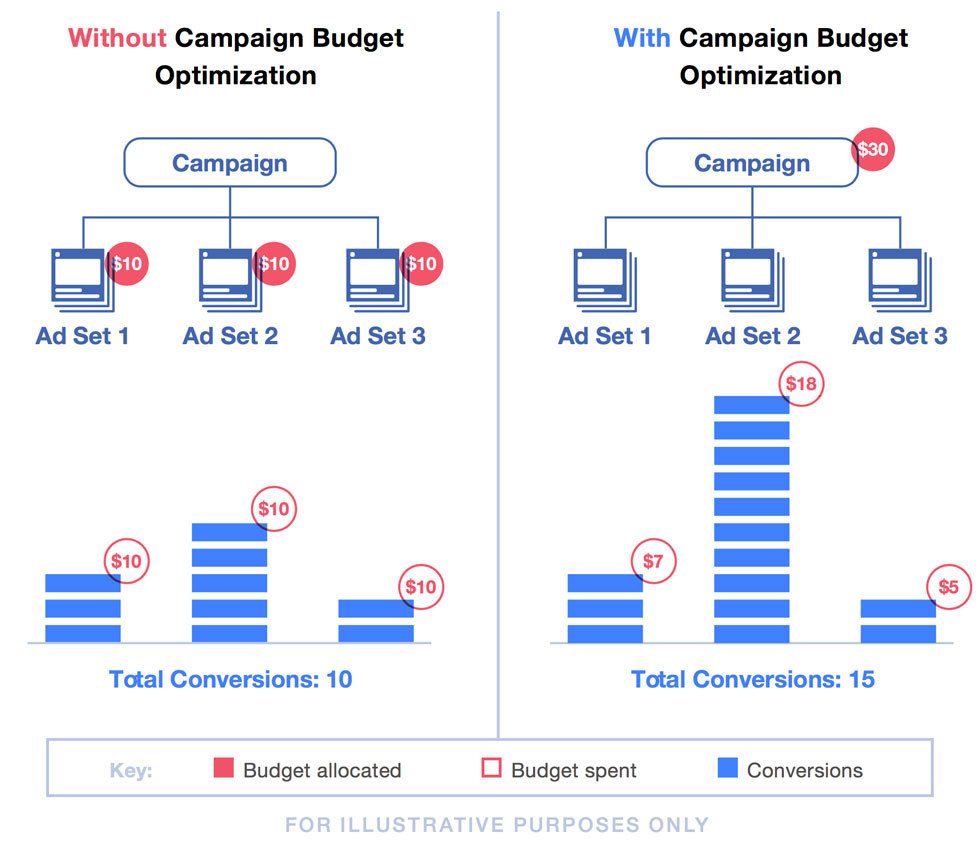
“Using campaign budget optimization, advertisers can set one central campaign budget to optimize across ad sets by distributing budget to the top performing ad sets in real time. Campaign budget optimization is available for any campaign objective and is best suited for campaigns with multiple ad sets.”
“With campaign budget optimization, advertisers allow Facebook to distribute their budget across ad sets to get the best results for their campaign.”
Translation: If you have multiple ad sets running in a campaign, Facebook is going to spend your money the way they see fit!
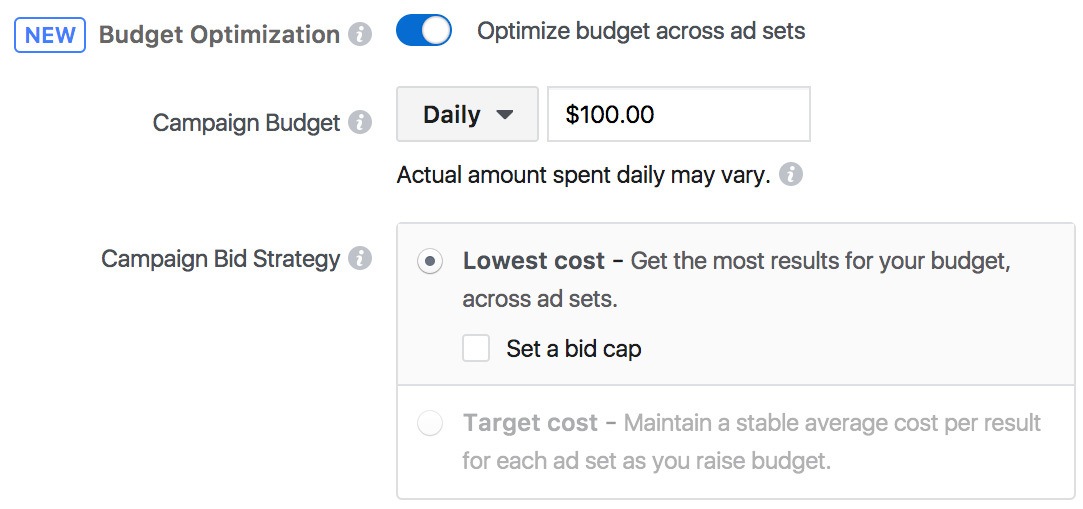
Here’s what it will look like:
That sounds scary, doesn’t it?
Keep reading...it’s not all bad:
“In addition to setting a daily or lifetime campaign budget, businesses can set bid caps and spend limits for each ad set.”
Translation: You still actually have quite a bit of control over how Facebook spends your money, but you have to be a little more thoughtful about how you set things up.
The Benefits of Campaign Budget Optimization
So...why are they doing it then?
Here’s what Facebook as to say.
“By distributing more of a budget to the highest performing ad sets, advertisers can maximize the total value of their campaign. Budget optimization works in real time to determine the most effective use of a business' ad dollars to help lower cost per result and increase return on ad spend.”
“Campaign budget optimization also saves advertisers time by eliminating the need to manually shift budgets between ad sets.”
Translation: We have much better data about our ad system than you do...so let us do the heavy lifting using Artificial Intelligence!
It’s Coming...Here’s What To Do.
This change is happening whether you like it or not, so the best thing you can do at this point is to accept it and get prepared. Here are our tips to help:
Tip #1: Test
You can start using Campaign Budget Optimization on your campaigns right now, so you might as well get some experience with it before it becomes mandatory. Set aside a small test budget and start running experiments.
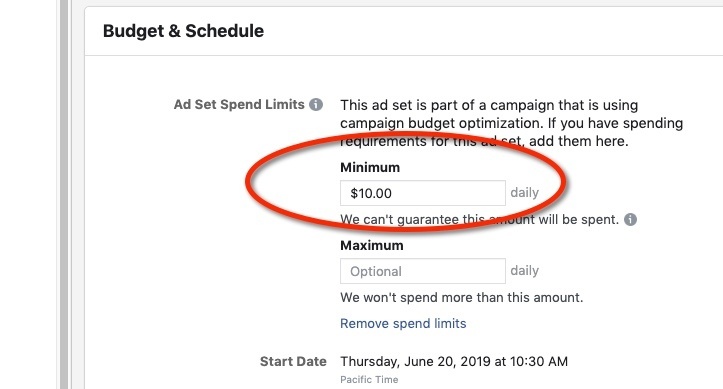
Tip #2: Use the ‘minimum budget per ad set’ setting
This is an optional setting that allows you to ensure that a particular Ad Set gets at least a certain amount of dollars spent on it. This is your way of making sure that Facebook doesn’t completely turn off traffic to a particular Ad Set.
It’s Time!
Campaign Budget Optimization will be a requirement very soon - it’s time to start preparing and testing so you’re ready!
Tip #3: More budget per campaign
Since your budget is now being split across all Ad Sets in your campaign, you need to make sure you are upping your budget.
Tip #4: Adapt and overcome!
Campaign Budget Optimization is new for everyone. The strategies for the optimization of this new setting are still theoretical, and you will make mistakes. That’s ok! Adapt and overcome! Continue to monitor your campaigns, learn, and make adjustments.
Building your audience is just as important as building your business. In fact, it is one of the main pillars of your business. Read on and learn the importance of audience listing.
Here’s what it means for your business
You no doubt heard over the years that you should build your list and that usually refers to building an email list.
Having a good list of prospects and customers that you can email on a regular basis is one of the easiest, most affordable and most effective ways to increase sales and build your business.
You should absolutely build your list. Though email marketing has become less effective due to the volume of email that's now being sent, it's still a very effective and important strategy for all businesses to take advantage of.
However, as the title of this article suggests,audiences are now the new list.
Audiences: The New List
Here's what we mean by audiences are the new list.
Audiences are a reference to the collection of people that you can build inside of an advertising platform like Facebook, Instagram, Google Ad Network, and LinkedIn that have interacted with your ads or your content or your videos or your website.
You can literally build a collection of people that you've had some sort of engagement. With your collection, you can then run ads to in the future.
This is, of course, an incredibly effective way of advertising because you are advertising to people that you know you. You already have some sort of relationship with the people you are advertising to.
That's very similar to being able to send an email to somebody that is already subscribed to your list because they have some sort of relationship with you.
How to build an Audience
Here's how to build audiences.
Every ad network, or social media platform, comes with what's called a pixel. A PIXEL is a small piece of code that you can put on your website that will then track any time a visitor comes to your website and notify the advertising networks that that's somebody that you can advertise to again.
What you want to do is get pixels from all the various social platforms and ad networks, add them to every page of your site, start collecting people and building those audiences by their interest in topics, products, and actions taken.
Pixels give you the ability to get enough information about where that person has visited on your site to know things like whether or not they're interested in a particular topic of a blog post, or if they viewed a particular category of product on your site, or they've watched a certain video.
You can get good detail from that pixel to give you more targeted advertising audiences.
Finally, you can promote your content and your offers to those audiences based on the audiences that they're in.
Final Thoughts
Again to recap, audiences are the new list.
You, of course, still want to build your email list. That's a very powerful marketing tool, but audiences are starting to prove to be just as effective, if not more effective.
Because you are not reaching somebody in their very, very crowded in box. You can instead reach them with a variety of content formats in the environments that they're already spending time on, namely the social media platforms and websites that they visit.
Meta Description: Building your audience is just as important as building your business. In fact, it is one of the main pillars of your business. Read on and learn the importance of audience listing.
Keywords: audience, list, building your audience, building your business, audience listing
While the industry is divided on the use of
blockchain in general, thanks to cryptocurrency, there’s no question that it
has plenty of promise in digital marketing.
Though blockchain got most of its attention from
Bitcoin, there’s much more to this technology than cryptocurrency. Blockchain
provides a method of digital record-keeping that keeps a ledger of transactions
that is transparent and can’t be altered, providing more security than other
technologies.
The many advantages of blockchain have already led
to its implementation in several industries, notably in finance and healthcare,
but it holds a lot of potential for digital marketing.
Find out how blockchain could affect digital
marketing and what benefits it holds.
What is Blockchain?
Blockchain
is an electronic public ledger that can be openly shared among separate users,
creating an unchangeable record of transactions. Each transaction has a
time-stamp and a link to the previous transaction, so it’s impossible to alter.
Each digital record or transaction is called a
block, and it allows either an open or controlled group of users to participate
and alter the electronic ledger. It can also only be altered or updated with
agreement among all participants, and once new information is entered, it can’t
be erased. As a result, a blockchain has a true and verifiable record of every
transaction that ever existed within the system.
Blockchain is also without an administrator, since
the blockchain users are the administrator. Blockchain ledgers can be managed
autonomously to exchange information between parties, much like collaborative
software or a peer-to-peer network.
Though blockchain is often called a technology,
it’s more accurate to refer to it as an architecture creating an unchangeable
ledger of transactions.
Data Collection
The internet is accessible to anyone through
ISPs and web browsers, the two gatekeepers. Both of these record and analyze
all our online behavior to gain insights about us and apply it to our online
searches and future marketing efforts.
Unfortunately, these gatekeepers don’t always
offer fair and ethical access to the web, and the recent headlines have proven
our personal data is easily bought and sold.
This is where blockchain comes in. With a
network built on blockchain-verified signatures, your data stays with you. This
is in stark contrast to it floating around servers which are owned by the
application you’re using, such as Facebook. With this network, visiting a
website would allow you to keep your own personal information, without
contributing to a running log of the people who also visited the website. As a
result, all your personal information will be encrypted and protected.
While this is a great thing for individuals, it
can be scary for marketers. Without access to user data, marketers would need
to gather data directly from prospects and customers to get a full picture of
the audience.
User experience could change too. Though you
should already be putting a lot of effort into user experience now, blockchain
could offer the opportunity for users to voluntarily decide which content and
advertisements they want to view.
Digital Display Marketing
Online display ads are riddled with flaws and
problems, regardless of whether some businesses see results. For a marketer,
online display ads can be expensive, complex and difficult to manage, and the
inventory is controlled by Google and Facebook almost exclusively.
The problems that arise from digital advertising
in terms of user experience are well known. Display ads are disruptive,
intrusive, irritating and waste your battery and bandwidth.
However, a blockchain browser with a Basic
Attention Token (BAT) can fix all the issues with ads. By trading on the value
of online attention, blockchain can incentivize users to view content and break
up the monopoly on digital ads.
It works like this: marketers buy ads with BAT,
which are found in private tabs or landing pages. Users who choose to view ads
are compensated with BAT, so they’re only seeing the ads they want to see.
As a result, marketers get more accurate
consumer information, and users get to learn about only the brands they choose.
Users also receive a portion of the marketer’s BAT in exchange for their
attention.
Publishers are also compensated by both users
and marketers through the revenue-sharing program. Publishers receive a higher
portion of the ad spend than the users, however, and may choose to charge BAT
for premium subscriptions and content.
This is really a win for everyone involved.
Marketers get more accurate, targeted data to tailor future campaigns, publishers
earn revenue and control over the message, and users get only the most relevant
ads they actually want to see. Users can also do so without risking their
personal information.
Just like buying a subscription to a print
publication you wanted to read in the past, BAT shows the value of a user’s
attention and puts them back in control.
Privacy and Trust
Privacy and brand trust are two overarching
issues in the digital world, which leads many users to become skeptical and
discerning about who they give their information to.
Giving users control over the amount of personal
information they reveal lowers privacy concerns from the user perspective, as
well as promoting social responsibility from the marketer’s side.
Caring for your user’s data and privacy are
important anyway, so putting effort into improving any shortcomings should
already be on your to-do list. With blockchain, however, the businesses that
prioritize user privacy will become more apparent and earn more trust from
users, building your brand relationships.
On top of that, studies show that users are more
willing to voluntarily provide personal information, with permission, if
there’s a reward for their trust. If you’re paying users directly to view your
ads and content, you’re more likely to get their information and continued
support in the future.
Ownership and Security of
Assets
Piracy was a problem in the past, which led to
sites like Pandora and Amazon Music, Unfortunately, artists are only
compensated pennies per stream, and the complexities of the music industry
meant that streaming service payments don’t always go to the appropriate
person.
With blockchain, artists, filmmakers, musicians,
photographers and other creative professionals have the opportunity to provide
their pieces to the huge audience without the use of an intermediary. They can
gain value for their tokens as they become more popular as well, earning more
for their work.
The downside for the marketer is that this would
give artists the tools necessary to market themselves directly to their audience,
without sacrificing their revenue. This would give artists a chance to be
valued for their work, however, and not because they know how to become a
corporate product.
Looking to the Future
Though these possibilities are very real,
they’re likely far off in the future. For now, we’re seeing blockchain in its
infancy and learning more about how it could have positive benefits for user
experience and marketing. With that in mind, it’s important to consider the
implications for the future.
One thing is for sure, however: right now, some
of the best minds in the industry are working on blockchain and cryptocurrency
to adapt it to different business models and industries, so there’s likely to
be a lot of development in the near future.
Meta description: Find out how blockchain is
poised to shape the future of digital marketing and what you can expect from
this emerging technology.
Keywords: blockchain, marketing
Social post: Wondering how blockchain may impact
digital marketing? Find out here
Here are the biggest digital marketing trends
leading into 2019:
Topic Clusters
Search engines are now favoring clusters of
content that surround a particular topic, as opposed to keywords. If you want
to stay at the top of the search rankings, you need to develop these content
clusters that link to one another.
To do this effectively, you need a broad topic
outline that covers the most pertinent subcategories. Then, the surrounding
content should have specific, long-tail keywords that connect back to the
original outline with the same keyword.
This boosts your overall performance since any
page performing well will result in the entire cluster performing well. This
moves you further and further up the rankings.
In addition, choosing topics in which you have
proven subject matter expertise or knowledge will give you an even better
ranking, since search engines are now prioritizing the value and relevance to
the user.
Shorter Video Ads
Internet users have much shorter attention spans
than they once did, so it’s possible to lose a viewer with a long video that
would’ve worked a few years ago. Audiences tend to engage with shorter ads,
such as under 10 seconds, so you’re also getting more for your efforts.
Businesses are more likely to use shorter video
ads in the coming year, so you want to work these into your strategy to ensure
you stay with the current trends.
Chatbots
Chatbots are becoming more popular, due to their
ability to address basic customer service needs and help businesses interact
with more customers. Chatbots also create two-way communication between your
audience and your business, which improves your customer satisfaction and your
response time to messages. Both of these aspects will boost your search engine
ranking.
Chatbots have a reputation for providing negative
user experience, leading many businesses to hesitate to include them in their
marketing strategy. Overall, however, customers are pleased with the use of
chatbots and the ability to access information 24/7, so there’s no reason to
hold back on this trend.
Chatbots also operate in Facebook messenger
often, which has a click-through rate of 80 percent. This offers incredible
potential for how a chatbot can lead to more sales for your business.
Blockchain
Blockchain is quickly becoming a necessity for most
industries, but one of its most overlooked potentials is in marketing.
With the poor attention span of many internet
users, it’s more difficult to draw attention from content and keep your
audience engaged. Blockchain can be used to incentivize customers to watch
advertisements and engage in some way, whether it’s sharing, tagging, liking or
commenting, through a Basic Attention Token (BAT). This technology breaks up
the monopoly of digital ads to trade on the value of online attention and
engagement and reward the audience that’s willing to interact.
Influencer Marketing
Social media influencers are achieving more
influence in recent years, gaining significant followings on multiple social
media platforms. Social media isn’t new, of course, but its reach is continuing
to grow. Positioning yourself with the right social media influencer can make
all the difference.
In the past, businesses were able to have
influencer endorse products openly, but consumers are becoming more aware and
are less receptive to this marketing tactic. Because of this, a subtle approach
is needed to gain the benefits of a social media influencer.
Businesses with successful social media
influence develop mutually beneficial, long-term relationships with
influencers, so both receive more organic endorsements. These relationships not
only provide you with a steady outlet for your promotions, but it also makes
influencers less likely to abandon your brand.
Transparency
Fields like advertising, marketing and sales
have a negative connotation, with the belief that these representatives are
only out for their own interests, using deceptive and aggressive tactics to get
sales.
As a result, consumers are more skeptical and reluctant,
as well as being more difficult to impress. The easy access to reviews and
testimonials also gives them more information about a product or service’s
strengths, and more importantly, its weaknesses.
Now, businesses are addressing this issue with
transparency, openly admitting its own shortcomings, faults and negative
feedback to show loyalty and dedication to customers. They’re also encouraging
two-way communication on a public forum to not only build more trust with a
specific customer but also to show their efforts to other potential customers.
Mobile Optimization
Though it may seem obvious, mobile optimization
is one of the most important aspects of your digital marketing strategy to
address in 2019. Though many businesses already work toward mobile-friendly
sites, more and more users are switching to mobile. Google is even prioritizing
mobile-friendly sites in search rankings.
With so many users going mobile, you can’t
afford to lose a follower because of poor optimization. Small issues, such as
links too close together, a poor zoom function or text that’s too small can be
all it takes for a customer to abandon your site and move on to the next.
Voice search is on the rise, thanks to personal
assistance devices like Amazon’s Alexa, Google Assistant and Apple’s Siri.
Nearly one-third of the 3.5 billion searches performed each day are voice
searches, which use natural human speech patterns to determine the searcher’s
intent.
If you think you can use the same strategy for
voice search, however, think again. Voice search differs from a desktop or
mobile search in that you get fewer results. If you want to be one of the sites
that comes up, you need to tailor your SEO strategy for voice search.
Voice recognition technology is only expected to
improve and become more popular as well, which has the potential to disrupt
marketing altogether. User experience and SEO have been the main focus of most
marketing campaigns, but these aspects become irrelevant with a short search
and no search results screen.
While there’s no clear answer to tailoring your
strategy for voice search, a bit of brainstorming to understand the nuances of
the human voice. How users tend to phrase voice searches and what types of
phrases are prioritized is worth your effort.
Artificial Intelligence (AI)
Artificial intelligence has become a hot topic
in marketing recently, and though many are still unsure of its applications and
limitations, it’s starting to find its place in marketing campaigns.
A widely implemented form of AI is chatbots,
which improve customer service with lower costs and fewer resources. They’re
also quicker than humans and offer targeted, personalized services to any
customer at any time.
On a larger scale, the same capabilities of AI
that make chatbots so effective can be applied to many aspects of marketing,
such as forecasting, personalization, segmentation, and data analysis. The
possibilities are truly endless, so it’s best to get on board before AI takes
the marketing world by storm.
Final Thoughts
Marketing trends come and go, some of which
reshape the industry and others that may just fade into the background. If you
want to be successful in your marketing efforts year after year, it’s important
to be able to identify the upcoming digital marketing trends and stay ahead of
the competition.
Meta description: From chatbots to social media
influencers, here are the top digital marketing trends leading into 2019 that
you should include your strategy now.
Keywords: digital marketing trends 2019
Social post: Are you ready
for 2019? Check out the upcoming trends we’re looking out for.